
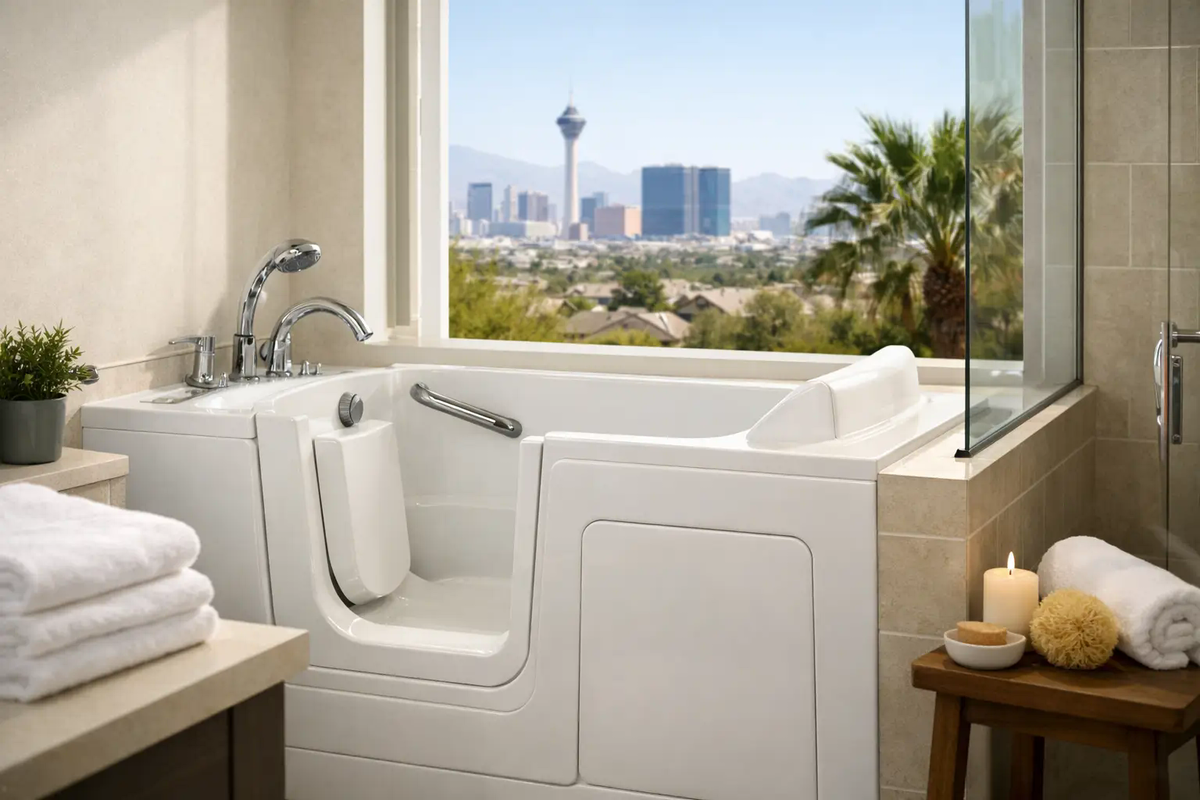
A traditional bathtub asks you to do the hardest part of bathing while standing on one foot: lift a leg over a high wall, balance on a wet surface, and lower yourself down. For many homeowners considering walk in tubs Las Vegas, that routine has become uncomfortable, uncertain, or dependent on someone else being nearby. A safer bathing setup is not about giving up independence. It is often how people keep it.
For Las Vegas and Henderson homeowners, a walk-in tub or sit-in bath can remove the biggest obstacle in the room: the tub wall. The goal is simple: No Step. No Slip. No Stress. But choosing the right product requires more than picking a tub with jets or comparing a few advertised prices. Door design, fit, installation, daily usability, and the company behind the work all matter.
Why the Standard Tub Becomes a Safety Problem
A bathroom fall can happen quickly, especially when water, soap, fatigue, arthritis, poor balance, or a recent surgery are part of the picture. The tub is a common trouble spot because it combines a high step, limited handholds, and a slick floor. Even a homeowner who manages well most days may struggle after a knee replacement, an illness, or a temporary injury.
Many families recognize the problem gradually. A parent starts skipping baths because getting in feels risky. A spouse waits outside the bathroom in case help is needed. Someone begins relying on a shower chair that still requires stepping over the tub wall. These are reasonable adaptations, but they may not solve the underlying hazard.
A sit-in bath changes the sequence. Rather than stepping over a conventional tub wall and lowering down, the bather enters through a low threshold, sits first, and bathes from a stable seated position. That can preserve privacy and reduce the need for hands-on assistance from a family member or caregiver.
What Makes Walk-In Tubs Safer to Use?
Not all walk-in tubs operate the same way. The most useful features are the ones that make the everyday entry, exit, and bathing process more stable and less complicated.
Secure Bath's signature design uses a 180-degree outswing door with a durable aluminum door and frame. The door swings completely outward, giving the user room to approach, turn, and sit down before closing the door. This is a meaningful difference for people with limited mobility and many wheelchair users. Instead of trying to maneuver around an inward-opening door inside a compact tub, the user can position themselves comfortably first.
The aluminum door and frame are also designed for lasting, frequent use. A tub door is not a decorative detail. It is a moving part that needs to close securely day after day while remaining easy to operate. When comparing tubs, ask to see how the door works in person, not just in a brochure.
Other practical safety features include a low entry threshold, molded seating, grab bars positioned where they are actually useful, and slip-resistant flooring. Hydrotherapy can be a welcome comfort feature for sore muscles or stiff joints, but it should not distract from the basics. A tub must be easy to enter, easy to sit in, and easy to exit before any extra feature becomes valuable.
Walk In Tubs Las Vegas: Choosing for Real Life
The best bathing solution depends on the person, the bathroom, and the household's plans. A walk-in tub is often a strong choice for someone who prefers soaking baths, wants seated bathing, or has difficulty with balance and leg movement. It can also work well for homeowners who want to age in place and make one thoughtful remodel rather than revisit the bathroom after needs change.
That said, a walk-in tub is not automatically the right answer for every home. Because the tub must fill and drain while the user is inside, the person needs to be comfortable sitting for that time. Fast-drain systems can help, but it is still a factor worth discussing honestly. The bathroom's plumbing, electrical capacity, layout, and available space also affect the final recommendation.
For someone who strongly prefers a standing shower, a curbless or roll-in shower with seating and grab bars may be a better fit. A tub-to-shower conversion can be especially useful when a low threshold and easy wheelchair access are the top priorities. The right choice is the one that supports safe, comfortable bathing now and still makes sense as circumstances change.
A practical example
Consider a Henderson homeowner recovering from hip surgery. A standard tub may be manageable again eventually, but getting over its wall during recovery may be unsafe. A temporary workaround can help for a few weeks. If balance challenges, arthritis, or caregiving needs were already present before surgery, however, that recovery period may reveal a longer-term issue worth addressing.
Planning ahead does not mean assuming mobility will decline. It means recognizing that a bathroom designed for easier access offers more options. A well-chosen sit-in bath can support the homeowner after an injury, during recovery, or years down the road without requiring another major remodel.
Understanding Walk-In Tub Cost and Value
Walk-in tub costs vary because each project is different. The tub model, door style, therapeutic features, plumbing updates, electrical work, wall surrounds, flooring repairs, permits, and bathroom modifications can all affect the price. A quote that seems unusually low may leave out necessary installation work, while a higher quote is not automatically better value.
The useful question is not simply, “What does the tub cost?” It is, “What is included, and will this solution work safely for the person using it?” Ask for clear written details about the product, installation scope, warranty, cleanup, and any work that could add to the final price. There should be no mystery and no artificial urgency.
A quality accessible bathing project can be a meaningful investment. Its value comes from reducing a difficult daily task, supporting independence, and helping a homeowner remain comfortable in the home they know. For families, it can also provide peace of mind without turning every bath or shower into a stressful event.
How to Compare Local and National Providers
Large national brands may have broad advertising reach, while a local company can offer a more personal consultation and local accountability. Neither company size nor company age tells the whole story. Products improve, materials change, and newer designs may offer better usability and value than older models.
Compare the actual product and the actual service. See the door operation. Sit in the tub if possible. Ask who performs the installation and who answers the phone if a concern arises after the project is complete. A company should explain limitations as readily as benefits.
Reviews deserve a careful look, too. Do not rely only on an overall star rating or a handful of glowing comments. Read negative reviews and look for patterns involving communication, installation quality, warranty service, unresolved problems, or how complaints were handled. Every business can have an unhappy customer. What matters is whether the response shows responsibility and respect.
A no-pressure in-home consultation should feel like a conversation, not a sales performance. The consultant should measure the space, ask about the user's mobility and bathing preferences, explain realistic options, and leave you with information you can consider at your own pace.
Installation Is Part of the Safety Decision
An accessible tub is only as good as its installation. Proper measurements matter because bathrooms in Las Vegas Valley homes vary widely, from older homes with compact tub alcoves to newer homes with larger primary bathrooms. The installer may need to adjust plumbing, add electrical service for certain features, repair surrounding walls, or improve the flooring transition.
Professional installation also helps ensure that grab bars, thresholds, door clearances, and controls are set up for the person who will use them. A feature can look good on a plan and still be inconvenient if it is placed without considering reach, turning space, or transfer needs.
For homeowners in Las Vegas, Henderson, and nearby Southern Nevada communities, working with a local specialist can make that planning more straightforward. Secure Bath focuses on customized recommendations rather than forcing every household into the same package.
If bathing has started to feel like a task you have to brace for, it is reasonable to explore options before a fall or a difficult recovery forces a rushed decision. A free, no-pressure in-home consultation can clarify whether a walk-in tub, sit-in bath, or accessible shower is the better fit. The most helpful bathroom upgrade is the one that lets you close the door, bathe comfortably, and feel at home in your own home.
Questions about walk-in tubs? Ask away
Free in-home consultation: call (702) 789-7780
Get a free quote →