
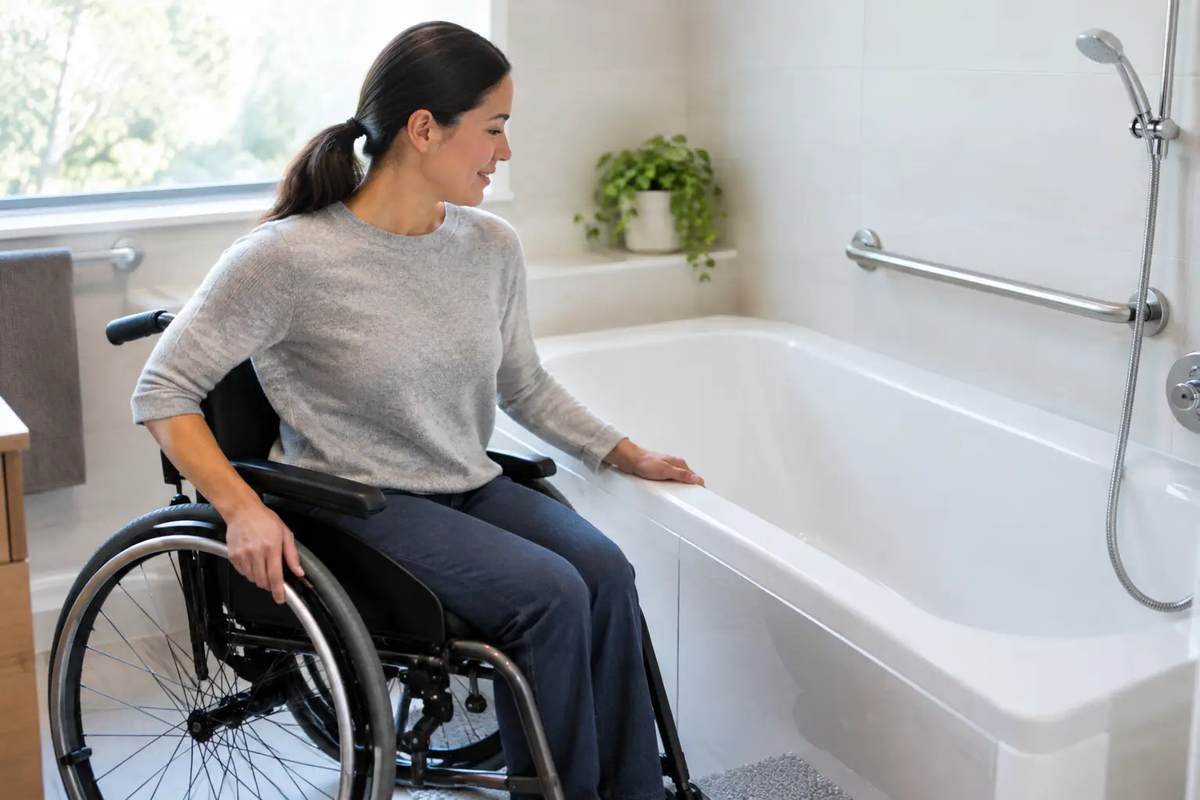
A bathtub can be the most difficult part of the home for someone who uses a wheelchair. The question, can wheelchair users use bathtubs, does not have one answer because it depends on the person’s transfer ability, balance, upper-body strength, bathroom layout, and the type of tub. What matters most is whether getting in, bathing, and getting back out can be done comfortably and with reasonable confidence.
For some wheelchair users, a traditional bathtub remains usable with the right transfer equipment and caregiver support. For others, stepping or sliding over a high tub wall creates too much strain. A sit-in bath or a roll-in shower may offer a more practical path to independent bathing.
Why a traditional bathtub can be challenging
A standard tub is designed around standing, stepping over a high sidewall, and lowering down into the tub. That sequence can be difficult even for people who walk independently but have limited balance or joint pain. For a wheelchair user, the challenge is usually the transfer from the wheelchair to the tub edge, bench, or seat.
A transfer may be possible when a person has good upper-body strength and can shift their weight safely. A properly placed transfer bench can help: one end sits outside the tub, allowing the user to sit down from the wheelchair and slide across the bench into the bathing area. Grab bars and a handheld showerhead can also make the setup easier to use.
Still, a transfer bench does not remove every issue. The person must manage the tub wall while sliding, maintain balance on a wet surface, and have enough space for the wheelchair and the bench. A caregiver may be needed, especially after surgery, during a temporary recovery, or when strength changes over time.
Can wheelchair users use bathtubs with a transfer bench?
Yes, some can. A transfer bench is often the most economical way to make an existing tub more usable without remodeling the entire bathroom. It can work well for a wheelchair user who can transfer independently or with limited assistance.
Before relying on one, consider the full bathing routine rather than the transfer alone. Is there enough clear floor space beside the tub? Can the wheelchair approach the bench at the right angle? Are the faucet controls easy to reach from a seated position? Can the user dry off and transfer back without twisting or reaching too far?
A bench also places part of the bathing process outside the tub. Water can drip onto the floor, so non-slip flooring, absorbent mats that do not bunch up, and careful shower curtain placement matter. This solution can be useful, but it may not feel simple or comfortable for everyone.
When a sit-in bath may be a better fit
A sit-in bath is designed to reduce the problem of stepping over a conventional tub wall. Instead of climbing into a tub, the bather opens a watertight door, enters through a low threshold, and sits down on a built-in seat before bathing.
Secure Bath’s sit-in bath has a 180-degree outswing door with a durable aluminum door and frame. The door opens outward fully, which can provide a wider approach for someone coming from a wheelchair or using a walker. The user can sit first, then close the door, rather than trying to balance while stepping into a deep tub.
That difference is practical. A wheelchair user who can stand briefly and pivot may find the wide-opening door and built-in seat far easier than moving across a tub wall. Someone who transfers with help may also give a caregiver more room to assist. The best option depends on the person’s specific transfer method and the available space around the tub.
Once seated, features such as grab bars, slip-resistant surfaces, and a handheld showerhead can make bathing more manageable. These features do not make a bathroom risk-free, but they can reduce unnecessary reaching, standing, and awkward movement. That is the simple idea behind No Step. No Slip. No Stress.
A sit-in bath is not the same as a roll-in shower
It helps to separate two accessibility needs: transferring into a seat and rolling directly into the bathing area. A sit-in bath is often a strong choice for people who can transfer from a wheelchair to a fixed seat, with or without some assistance. It is not usually the best choice for a person who needs to remain in their shower wheelchair throughout bathing.
A curbless or roll-in shower may be more appropriate in that situation. These showers have little or no threshold and can be designed for a shower wheelchair. They generally require a more involved remodel because flooring, drainage, waterproofing, and bathroom clearances all need careful planning.
A walk-in shower can also be a good alternative for people who prefer showering and do not want to wait for a tub to fill and drain. On the other hand, a seated soak can be more comfortable for homeowners who enjoy bathing, experience stiffness, or simply want the security of a fixed seat. There is no universal winner - the right choice is the one that matches how the person actually moves and bathes.
Questions to answer before choosing a bathing solution
A thoughtful decision starts with an honest look at current needs and likely changes. Consider whether the wheelchair user can stand and pivot, whether they need one or two people for assistance, and whether they can safely transfer onto a bench or built-in seat.
Also look closely at the bathroom itself. Doorway width, turning space, toilet placement, plumbing location, and the position of the wheelchair all affect what can be installed. A bath that looks accessible on paper may be frustrating if the door cannot open fully or the user cannot line up for a transfer.
The bathing preference matters, too. Some homeowners want a bathtub because soaking is part of their routine. Others want the fastest, most direct shower setup. For couples sharing one bathroom, it can be useful to think about both people’s needs now and later instead of planning around only one temporary limitation.
Planning ahead can avoid a second remodel
Many families first consider accessible bathing after a fall, a hospital stay, or a difficult recovery. Those events can reveal that a familiar bathroom no longer works as well as it once did. But planning before a major mobility change gives homeowners more time to compare options and make decisions without pressure.
For Las Vegas and Henderson homeowners who intend to stay in their homes, an accessible bathing update can be part of a broader aging-in-place plan. The goal is not to assume that every person will need the same level of support. It is to choose a bathroom that can adapt to changing needs and preserve privacy where possible.
A sit-in bath can be especially worthwhile for someone who currently transfers independently but finds a conventional tub wall increasingly inconvenient. Installing it before bathing becomes a daily source of worry may mean avoiding another major bathroom change later.
What to expect from an in-home assessment
An in-home consultation should focus on the person, not just the product. A knowledgeable local installer can measure the bathroom, discuss transfer needs, identify likely installation constraints, and explain whether a sit-in bath, walk-in shower, or another approach makes the most sense.
Ask clear questions about the threshold height, door swing, seat size, grab-bar placement, drainage time, installation scope, and total cost. It is also reasonable to ask how the recommended setup works for a wheelchair user with the same transfer ability as yours. Straight answers are more useful than a one-size-fits-all recommendation.
Secure Bath offers free, no-pressure in-home consultations for homeowners in Las Vegas, Henderson, and surrounding Las Vegas Valley communities. A conversation in the actual bathroom can make the decision much clearer than comparing photos or generic product descriptions.
The right bathing solution should make everyday routines feel more manageable, not more complicated. Whether that means a transfer bench, a sit-in bath, or a roll-in shower, start with how the person gets from the wheelchair to the water - then choose a setup that supports comfort, dignity, and the ability to remain at home.
Questions about walk-in tubs? Ask away
Free in-home consultation: call (702) 789-7780
Get a free quote →